Do you drink too much?

Let me preface this article by clarifying that I am not an anti-alcohol crusader. In fact, I just recently posted my recipe for the world’s best limoncello and also wrote an article about why you can still drink even if you are trying to get fit.

Each of us has to come to our own conclusions about alcohol and figure out how much is the right amount. For us. Not for anyone else, because we are all unique individuals.

I can only judge me, and I know I used to drink too much. No question. I would drink almost every night and would not stop until I was wasted. I even got a DUI back in the day.

That DUI was a wakeup call — sort of.

BeersAfter the DUI, I quit drinking for 90 days — court-ordered. Surprisingly to me at that time, I had no problem not drinking, even though I thought I would. I guess I took it as a challenge.

(Keep in mind that I am one of those people who follows the rules. I may not agree with the rules, but I always try to follow them, because I don’t want to suffer the consequences. This means I probably drive slower than I need to, pay more taxes than I have to, and generally miss out on some stuff that people who live looser and freer enjoy, but so be it. I prefer a more predictable life.)

After the 90 court-ordered days of sobriety were up, I went back to drinking, but not as much, and never when I was going to be driving. (Well, unless I was driving a golf cart. I narrowly averted disaster one day on the golf course while engaged in a cart race while driving backward. My cartmate ended up getting stitches in his head after he fell out….)

When I moved to Texas, I got into the local music scene, which meant I was spending a lot of time in bars with people who liked to get hammered, so ….

Fortunately, beyond the incidents described above, I never injured anyone or got into any kind of trouble from drinking.

But in the mid-2000s, when my doctor put me on a cholesterol medication that messed with my liver, that is when I quit drinking completely for 18 months.

So, honestly, while maybe professional I should have, I never came to any great epiphany about my consumption of alcohol. I quit because I felt my medical condition required it, and you know what? I enjoyed so much being able to drive home from the shows at night without worrying about cops in my mirror, that even now that my condition is resolved and I’ve hopped off the wagon, I don’t over-consume when I’ll be driving, and I often don’t consume any alcohol at all when I’m out. Saves me a ton of money, too.

Do I have as much fun as I used to? Nope. But I figure I’ve been there, survived that, no need to push the envelope, knowwhatimean?

How about you? Do you drink too much? Only you can decide. But maybe this questionnaire from the National Institute on Alcohol Abuse and Alcoholism can help.

The questionnaire is only 10 questions. There is a whole long assessment process, but if you simply answer the questions honestly and take a good hard look at the results, you should gain some insight into your drinking habits.

Maximum score is 40, and the higher your score is, the more problematic your drinking may be. I scored a 7. How did you do? What does that tell you about your relationship with alcohol? Is it time to make some changes?

Fitness versus Health – there is a difference

I remember when Jim Fixx died. You may not, so here’s a little about him. (You can read a short article about Fixx at Wikipedia.)

Jim Fixx is widely credited as being one of the pioneers of fitness. He started running at age 35, when he was overweight and a two-pack-a-day smoker. Ten years later he had lost 60 pounds, was smoke-free, and had written a best-seller about running.

Seven years after that, at the age of 52, Fixx dropped dead of a heart attack after a run.

This happened in 1984, and many people jumped on a bandwagon that claimed Fixx’s death proved that running is bad for you. There were even jokes circulating about it.

Jim Fixx
But what Fixx’s death was really displaying was the difference between fitness and health.

“Fitness” describes your body’s ability to do physical things, like running, lifting heavy objects, moving without pain.

Jim Fixx was a fit guy. He could run for miles. He was in shape.

But he was not healthy. The autopsy revealed that atherosclerosis had blocked one of Fixx’s coronary arteries 95%, a second 85%, and a third 70%.

Fitness does not necessarily lead to perfect health. There are always past behaviors, hereditary tendencies, and environmental factors that can bring disease to anybody, even the most fit people.

But you can severely lower your risk profile by getting into — and staying in — good shape.

I’ve witnessed this with my own body during my quest for fitness.

As I lost weight, I saw my blood pressure drop to normal, allowing me to stop taking two blood pressure medications my doctors had prescribed. I watched my bad cholesterol and triglycerides decrease drastically, and my good cholesterol increase dramatically. Pain I used to feel is now gone. I can run and climb steps without getting out of breath.

And all that increased fitness has led me to better health, lowered my risk of heart attack, cancer, and a host of other ills.

But I still struggle with my blood-sugar level. It’s down from where it was, but still borderline and doesn’t seem to be getting any lower. And this is happening in the face of the fact that I severely — and I do mean severely — cut back on consuming anything with added sugar about 18 months ago.

I haven’t given up looking for the answer to that health issue, but it’s there, even though I am more fit than I’ve ever been.

So fitness is one thing, health is another.

I often tell people that I may not outlive them, but it won’t be because I didn’t try.

How about you? Would you rather go out fighting, or lie on your deathbed, wondering why you thought everything else in your life was so much more important than getting fit?

RECIPE: World’s best limoncello, direct from Italy

I had never heard of limoncello before the summer of 2007. It was then that my then-wife and I embarked on a Mediterranean cruise, which included a visit to Sorrento, Italy, the birthplace of limoncello, and the place where they grow the largest lemons I’ve ever seen. I saw lemons at a market that were literally the size of my head!

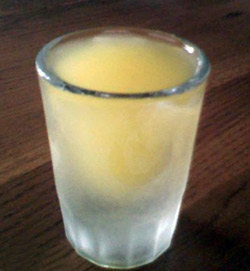
When we were in Sorrento, I had my first taste of this lemon liqueur called limoncello. It was great — lemony, very high proof, served very cold in a frozen shotglass, and it burned all the way down. The drink is meant to be a digestivo, which means it is served after a meal to aid in digestion.

Of course, you can use it to get hammered, too. And if you make it the way I do, it won’t take all that much.

limoncello

Not that I recommend getting hammered. I don’t have more than one drink of this stuff, except on special occasions.

Now, if you’ve had the limoncello that you buy in stores here in the U.S., you probably think it’s a sweet drink. Yeah, the stuff I’ve found in liquor stores is. But that’s not right!

The authentic limoncello I had in Sorrento was anything but sweet.

Fortunately, as I was sitting in the Sorrentan pizzeria, expressing to my then-wife how delicious I thought this drink was, the guy behind the counter overheard and proudly told me he made it himself.

“Really? How do you do that?” I asked.

He gave me the barest of recipes in broken English, but he did emphasize, “Use grain alcohol, not vodka!”

I took what he said and experimented until I arrived at what I feel is a very authentic home-made limoncello. The nice thing about making it yourself, of course, is that you can adapt it to your own taste, so feel free to do so.

How to make limoncello…

Ingredients

  • 1 liter of Everclear — Do NOT buy the lower-proof versions. Use only the 189- or 190-proof kind.
  • 5-7 medium to large lemons
  • 1 liter of clean water
  • 2 TB granulated sugar – You can use more or less to your taste. When I first made this recipe I used 3/4 cup!

Equipment

  • Vegetable peeler or grater to peel or zest the lemons
  • Wide-mouth 1.5 liter (or larger) airtight jar to store the Everclear and lemon peels during infusion
  • Something to remove the peels from the Everclear after the infusing is done, like a spaghetti spoon
  • Clean coffee filter to strain infused Everclear
  • Pot to heat simple syrup on the stove
  • Bottles to put your limoncello into when it’s ready — I like to use flip-top bottles, but you could use leftover Everclear, or any other, bottles
  • Large, plastic funnel to help you fill the bottles

Directions

  1. Wash the lemons to remove dirt and pesticides.
  2. Peel or zest the YELLOW ONLY from the lemons. Try not to get any white. I peel, because it’s easier.
  3. Combine Everclear with the lemon rind in a resealable airtight widemouth jar.
  4. Steep for 14 to 21 days in a dark, cool place, like a cupboard. Turn the jar every couple days to mix it up a bit. Just one simple upside down turn, then back.
  5. On the last day of steeping, combine the water and sugar in a pot over medium-low heat.
  6. Stir the sugar-water mixture continually until all the sugar is dissolved and the syrup is clear.
  7. Remove from heat and allow to cool.
  8. Remove the peels/zest from the Everclear. I use a spaghetti spoon to pull them out, but however you can figure to do it is fine.
  9. Strain the infused Everclear through a coffee filter or some such thing to remove excess solids.
  10. Funnel half of the Everclear into each of two one-liter bottles.
  11. Fill the bottles the rest of the way with the cooled simple syrup.
  12. Put the bottles into the freezer.

Limoncello is best served in a thick frozen shotglass straight out of the freezer. It’s meant for sipping, not shooting, but do what you will.

By the way, I have also tried this recipe with oranges, tangerines, and limes. Oranges and tangerines — EXCELLENT! Limes — TERRIBLE!

If you want to be fit, you have to commit!

Did you ever have this conversation with yourself?

SELF 1: “It’s time to work out, but I have other stuff to do.”
SELF 2: “Sure I have other stuff, but I need to get my workout in!”
SELF 1: “Good point, but I already missed Wednesday, because of that big meeting. Might as well skip today, too, and get back into it on Monday.”

There are always things that can happen to take the place of your regular workout time. The boss calls a meeting. You get stuck on the phone with a client. Your kid is sick and you need to pick her up from school. Life gets in the way.

But if you are committed, what you do is shift the workout, do it anyway, earlier, later, whenever. If for some reason you really can’t get your workout in that day, you do it the next day.

And you never — never — use the fact that you missed the last workout as an excuse to miss the next one. That is a recipe for failure.

No matter how many days a week you plan to exercise — 1, 3, 5, 7 — you gotta stick to the schedule!

Have you seen the infomercial for Tony Horton’s P90X that includes the tagline/motto “Press play every day”? That is a powerful idea. The P90X program has something for you to do every day of the 90 days it lasts. Okay, well, one day a week is optional — you can either rest or join Tony in a stretching routine, so, really, they do allow you a day off every week, if you choose — and that’s a good thing.

But the idea that I needed to put that DVD into the player and “press play every day” — that little mantra — kept me going from time to time on those days when I was not so motivated, by reminding me of my commitment to P90X. In fact, it still reminds me now to get a workout in, long after having completed the program.

The financial gurus always tell you to prioritize your savings plan by “paying yourself first,” before all the money goes to bills.

Do the same with fitness. Prioritize it. Put your workout time above other things that are pulling at you. When you do that, you’ll find yourself truly committed to fitness, and that’s the only way you’ll succeed in the long run.

Do you have fitness goals? They might be your problem.

I have always loved school. I enjoy learning. I wish I could just be a fulltime student, but that’s not financially possible. Still, even as a non-student, I read a lot, do tons of research, all in an effort to learn something new, or learn more about my favorite subjects and activities. I just really enjoy learning new things, processing new information.

I believe that most people don’t share my love of school. They look at school not as a way to learn, but as a means to an end, a way to get a piece of paper that will allow them to get a better job, make more money.

People who look at school like that focus more on completing tasks — getting that papers or project done — rather than learning. They really don’t care if they learn, as long as they complete the tasks that allow them to collect the prize at the end. Of course, some learning cannot help but happen along the way, but it’s coincidental.

They have an ultimate goal for school, and that’s to get a degree. Once the goal is completed, well, that’s enough of school. Why do you think many professions have requirements for continuing education? Gotta force people to do it, because they won’t do it on their own.

So what does this have to do with fitness?

The nice thing about fitness is that a goal-oriented approach can work — at least for a while. Staying focused on completing tasks — hitting it hard every weekday 10:00am to 11:00am, for example — can help keep you in good shape and get you to your goal, whatever it is: losing 50 pounds, getting down to a 32 waist size, being able to do 300 pushups.

But what happens when you reach the goal? What happens on the other side? Too often, the fitness training stops, and, yup, we all know what happens after that. The fitness level gradually deteriorates, and we end up where we were before we started … or worse.

This fitness goal orientation is easily illustrated by a phenomenon I have noted recently because of my participation in Facebook.

Facebook has allowed me to follow people as they announce “I’m getting married in 9 months,” then, quite often soon thereafter, “I’m on a diet” or “I’m working out”.

This is great! Anything that motivates you to get into shape is okay in my book.

But I wonder how many of those people, motivated to look good on their wedding days, continue their fitness quests after the big day.

The problem is the goal. Once the goal is reached, what is the motivation to continue the behavior that was geared toward reaching it?

Fitness really has no end goal, it is an end unto itself. Sure, you can — and I do — have targets that get and keep you motivated. My most recent one was a strong desire to finish Insanity. Did it.

Now what? … Exactly. I could just quit, knowing I finished Insanity, and feel pretty good about that. But that would not keep me in shape.

So, it seems to me that while fitness can and should involve goals, we shouldn’t focus on those goals as be-all-end-alls. In fact, we should guard against this mindset.

Fitness is really a lifestyle. The goals are short-term pieces of a lifelong plan to get into and stay in shape. Use them, but don’t make them the primary focus. Keep your eye on your goals, but try to focus instead on fitness for fitness’ sake!